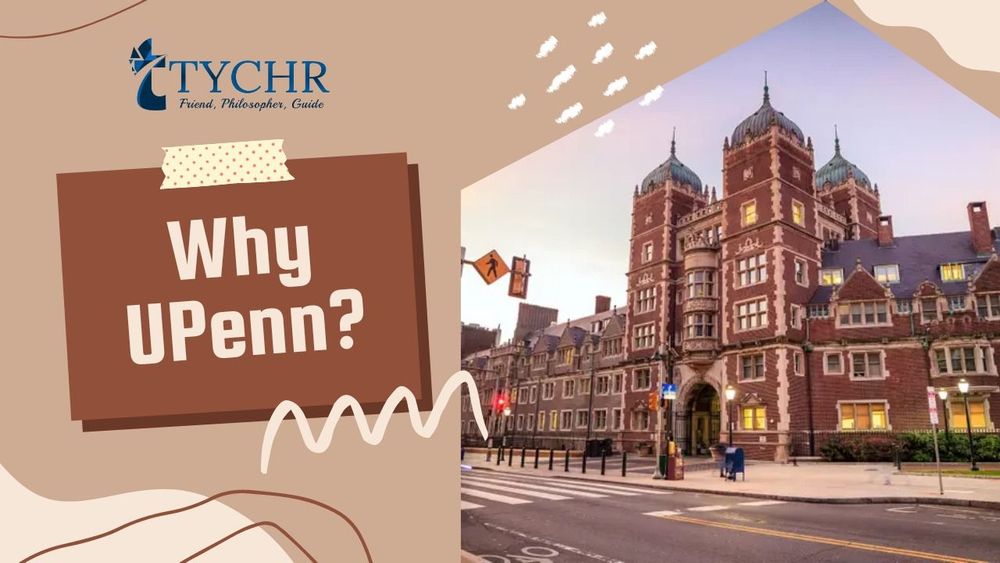
Why UPenn?
Tychr Team · 3 min read
Groundbreaking Research That Changes Lives
Visionary Leadership That Shapes the Future
- Penn’s founder, Benjamin Franklin, was a renowned inventor, scientist and visionary thinker. His spirit of innovation lives on at Penn today through groundbreaking research across disciplines that addresses society’s biggest challenges.
- Penn has a long history of trailblazing firsts, like awarding the first U.S. Ph.D. in 1883 and launching the first U.S. business school in 1881. Penn Medicine is a world leader in patient care, education and research.
- Penn’s president, Amy Gutmann, is a pioneering leader in higher education. Under her leadership, Penn has enhanced its excellence in education and research, expanded its campus, and integrated knowledge across academic disciplines to maximize impact.
- Penn’s board of trustees includes leaders from many fields who help steer the university toward continued preeminence. Penn’s administration, deans, department chairs, and faculty all share a vision of advancing knowledge for the benefit of humanity.
A Commitment to the Greater Good
- Penn’s Netter Center for Community Partnerships is one of the nation’s largest university-based community service programs. Through the Center, students can volunteer with local schools, community organizations, and nonprofits to help address issues like education inequality, health disparities, and economic hardship in West Philadelphia.
- Penn’s civic engagement courses provide students opportunities to apply their learning to real-world problems. For example, students in an urban studies class may help create policy reports for the Philadelphia City Council, while nursing students work with local clinics to promote community health.
- Student groups on campus organize drives for food, clothing, books, and other necessities to help those in need. They also plan fundraising events and awareness campaigns for important causes like environmental protection, human rights, and disaster relief.
- Upon graduation, many Penn students go on to careers in public service, working for government agencies, nonprofits, and social impact organizations. Their Penn education has instilled in them a duty to use their skills and knowledge responsibly to create positive change.
An Interdisciplinary Approach to Solving Complex Problems
- Penn was founded by Benjamin Franklin in 1740 with the vision of interdisciplinary education. This spirit lives on today through initiatives like the Perry World House, a global policy research center, and the Singh Center for Nanotechnology, which brings together scientists and engineers across disciplines.
- Undergraduate students can take advantage of over 90 interdisciplinary majors and minors, from Cognitive Science to Networked and Social Systems Engineering. Double majors that combine, say, Nursing and Anthropology or Digital Media Design and Computer Science are common.
- Penn’s 12 schools span a wide range of study areas, from the Wharton School of Business and the Perelman School of Medicine to the School of Engineering and Applied Science and the Annenberg School for Communication. Cross-disciplinary research and learning are deeply embedded in Penn’s DNA.
- This interdisciplinary ethos fosters an environment of openness, creativity, and innovation. Students learn to see issues from multiple sides and work with diverse teams to solve complex problems. Faculty have the opportunity to pursue bold research questions at the intersections of their fields.
- Notable interdisciplinary initiatives at Penn include the Penn Biden Center for Diplomacy and Global Engagement, the Penn Compact 2020, and the Penn Arts and Sciences Center for Native American and Indigenous Research. Each leverages expertise across schools and departments to drive progress on issues that matter.